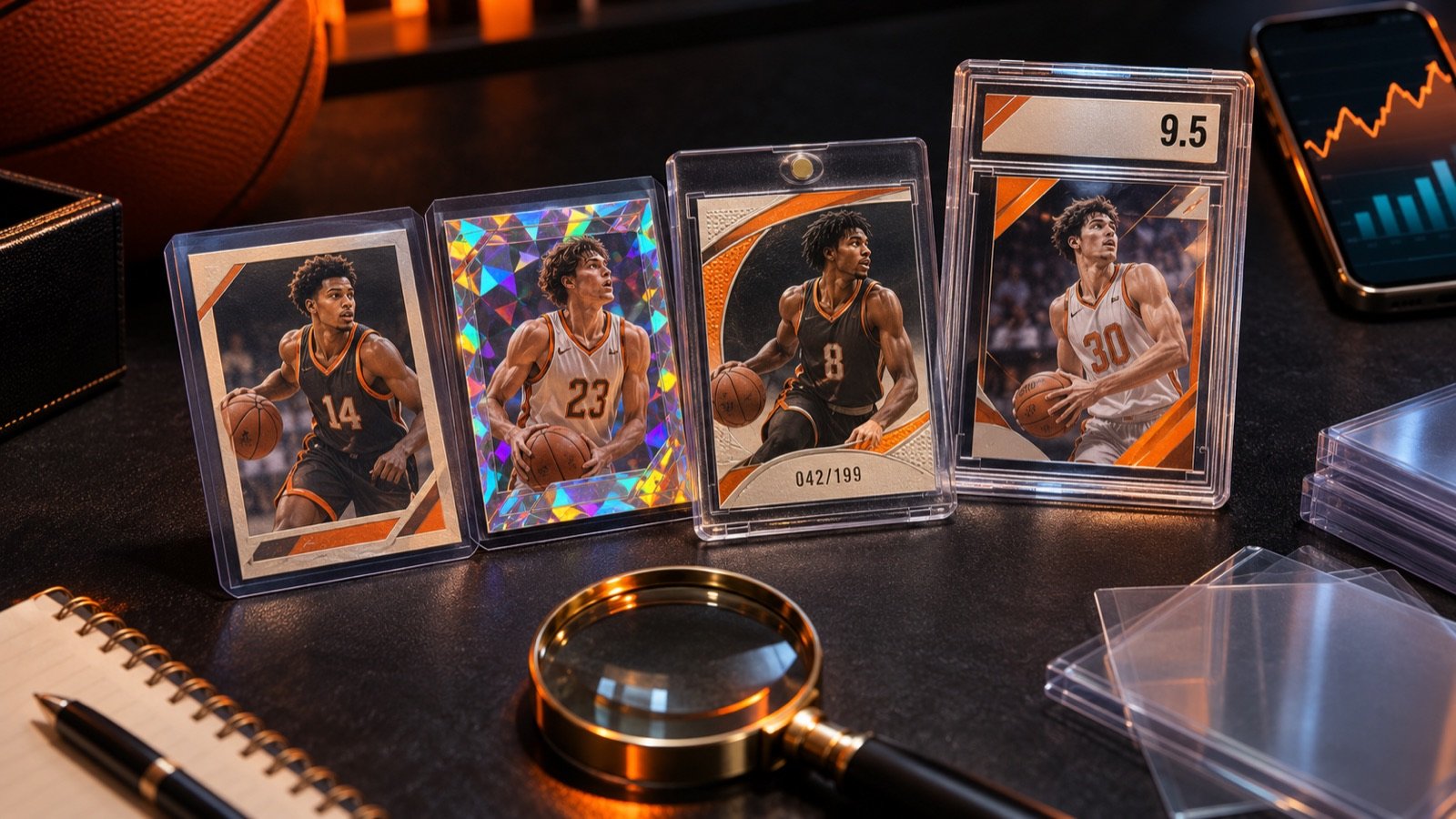
Australian basketball card value guide
Quick answer: a basketball card is worth what a real buyer is currently willing to pay for the same card in a similar condition. The most reliable starting point is a group of recent sold listings that match the year, product, player, card number, parallel and grade. Active asking prices provide context, but they do not prove market value.
This guide shows Australian collectors how to identify an exact card, search for useful comparable sales, handle numbered cards with limited data and calculate a sensible maximum buy price. It is educational information, not a guaranteed appraisal or financial advice.
If the terminology is unfamiliar, begin with our basketball card types guide. It explains base cards, parallels, inserts, numbered cards, autographs, relics and grading before you start comparing prices.
Step 1: identify the exact basketball card
Good valuation starts before you search for a price. Two cards showing the same player and photograph can have completely different values because one is the base version and another is a scarce parallel. Searching only a player name usually mixes together too many unrelated cards.
Record every detail you can find on the front and back. The most useful search string follows this order: year + manufacturer + product + player + card number + parallel + serial number + grade. An example structure is “2024-25 product name player silver parallel #123 PSA 10”.
- Year and season: use the season printed on the card or official checklist.
- Manufacturer and product: identify the brand family and specific release.
- Card number: usually printed on the back, sometimes with an insert prefix.
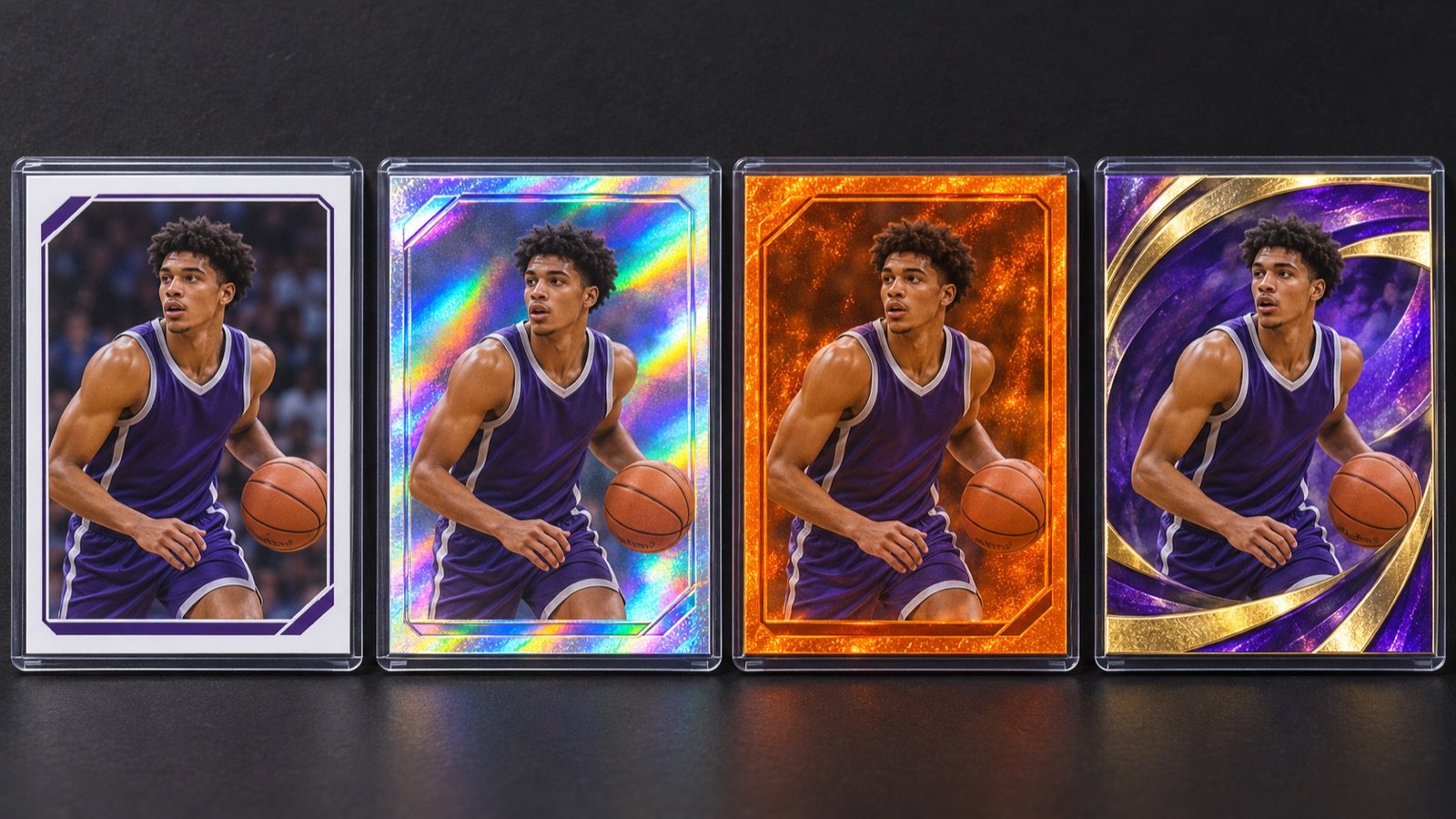
- Parallel or variation: note colour, foil, pattern, image variation and serial number.
- Autograph or memorabilia: distinguish on-card autos, sticker autos, jersey swatches and premium patches.
- Condition or grade: separate raw cards from professionally graded copies.
Step 2: find real sold comparisons
Collectors call comparable sales “comps”. A useful comp is a completed sale of the same card, or the closest defensible alternative when the exact card rarely sells. Asking prices are not the same as sold prices because a seller can list a card for any amount.
eBay Australia recommends checking completed listings when researching what similar items have sold for. Start with eBay’s official pricing guide, then use Advanced Search and select completed or sold listings. eBay says ordinary completed results cover recent activity, while eligible sellers can use Product Research for a longer history and additional metrics.
Build a clean group of comps
Aim for three to ten relevant sales when the market provides them. Sort by the most recent date and open each listing instead of trusting only the search title. Check the photographs, grade, card number and parallel. Remove lots containing multiple cards, damaged copies and unrelated variations.
- Use sold results, not only active asking prices.
- Prefer recent sales because player demand and card markets can change.
- Match raw with raw and the same grading company and grade where possible.
- Include postage when comparing the buyer’s total cost.
- Check whether the listing was an auction, fixed price or accepted offer.
- Use a median or middle sale rather than relying on one extreme result.
Median is usually safer than average
Suppose five matching cards sold for AUD 42, 45, 47, 49 and 95. The average is AUD 55.60, but the median is AUD 47. The median better represents normal sales because the AUD 95 result may involve an unusual bidding contest, an overlooked detail or a misleading listing.
Step 3: adjust for condition and grade
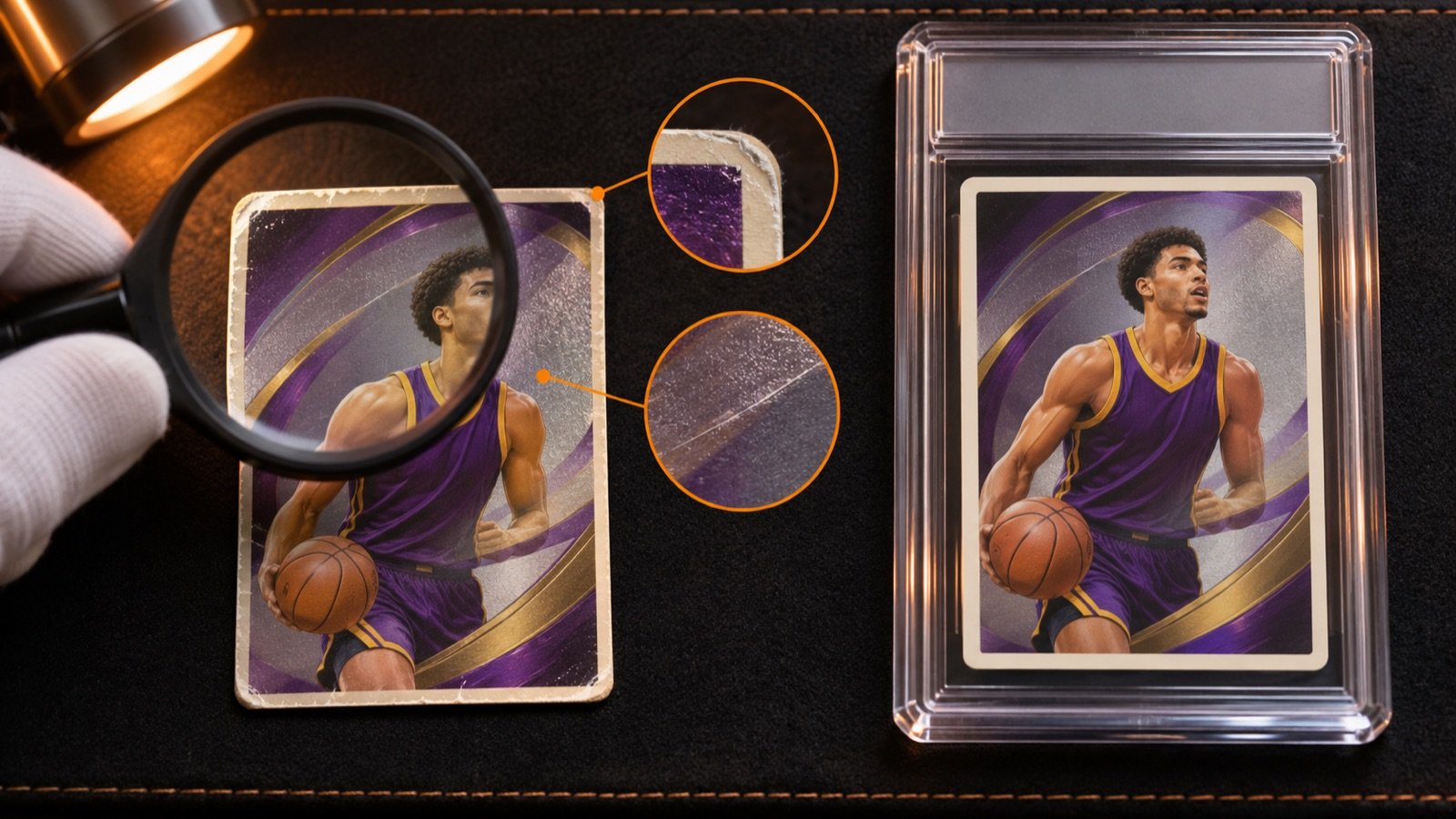
A comp is only useful when its condition is reasonably close to your card. A clean raw card should not automatically be valued like a PSA 10. A graded card has been authenticated and assigned a condition grade, while a raw card still carries uncertainty about surface marks, centering, corners, edges and possible alterations.
Inspect both sides under strong angled light. Look for whitening, dents, scratches, print lines, fingerprints, soft corners, edge chipping and centering problems. PSA describes a Gem Mint 10 as virtually perfect and publishes detailed grading standards. Beckett explains that grading evaluates centering, corners, edges and surface.
Raw versus graded value
A raw card may sell for less than a high-grade slab because the buyer accepts more condition risk. However, grading does not automatically create profit. A card might return a lower grade than expected, and the total grading, postage, insurance and selling costs can exceed the added value.
For a conservative raw valuation, compare with recent raw sales in similar visible condition. If every available comp is graded, treat the graded price as a ceiling rather than a direct value. Then subtract the expected grading cost, the chance of a lower grade and the time required to receive the card back.
Step 4: value numbered and rare cards
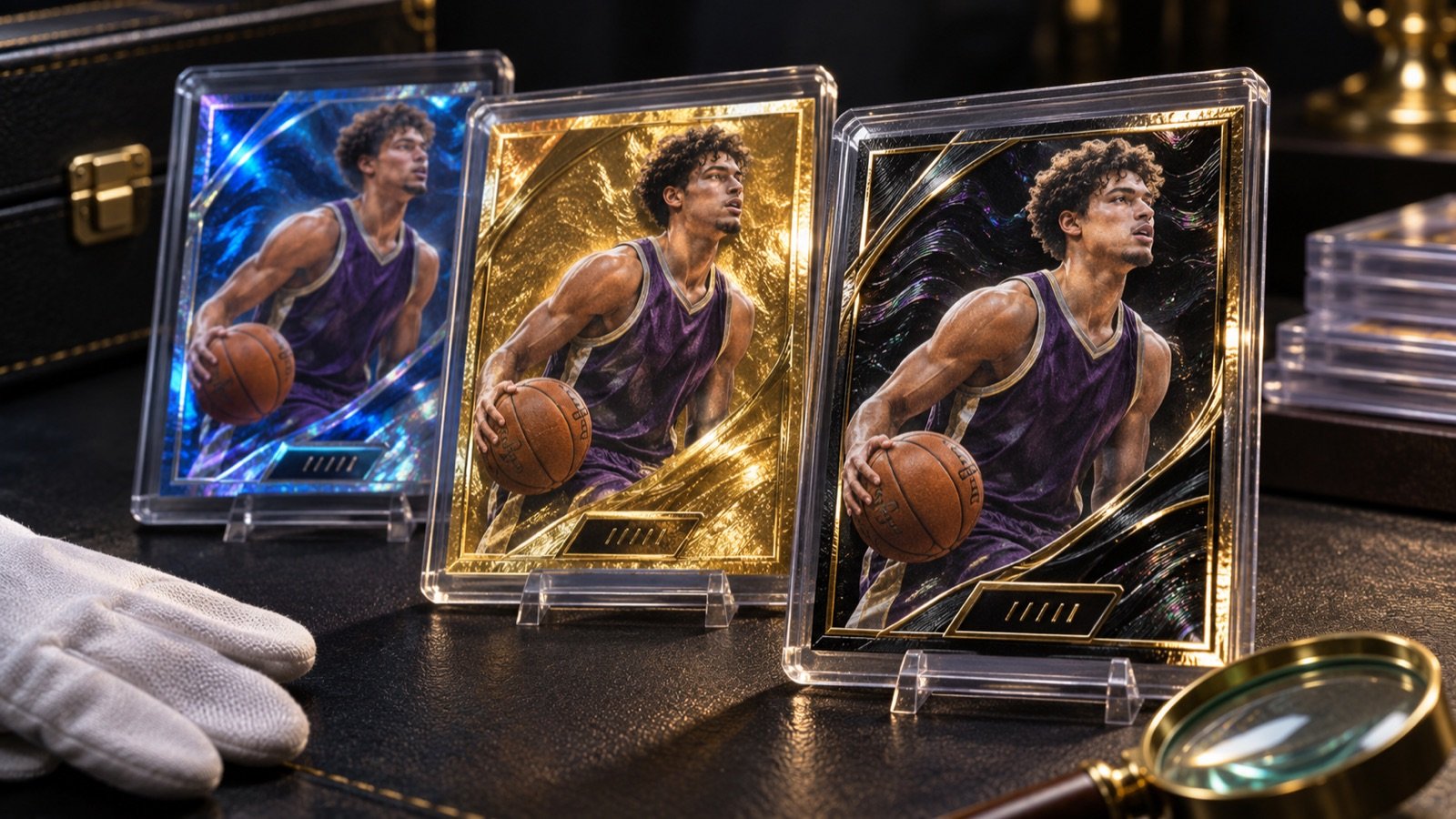
Serial-numbered cards are harder to value because the exact parallel may sell only occasionally. A card numbered to 10 should not be valued by simply multiplying the price of a card numbered to 100. Scarcity matters, but demand for the player, product, colour match, design and specific serial number also affects the result.
Start with the exact card. If no recent sale exists, widen the comparison one step at a time while keeping as many variables fixed as possible.
- The same player and parallel in a nearby grade or condition.
- The same player in the next closest print run from the same product.
- Comparable players from the same set and parallel.
- The same player in similarly regarded products and print runs.
- Older sales, adjusted cautiously for changes in player demand.
Jersey numbers, first copies and bookends
Some buyers pay more for a serial number matching the player’s jersey, the first copy in a run or the final copy. These premiums are real only when a buyer actually values that number. Do not automatically add a fixed percentage without supporting sales.
Step 5: calculate the true Australian cost
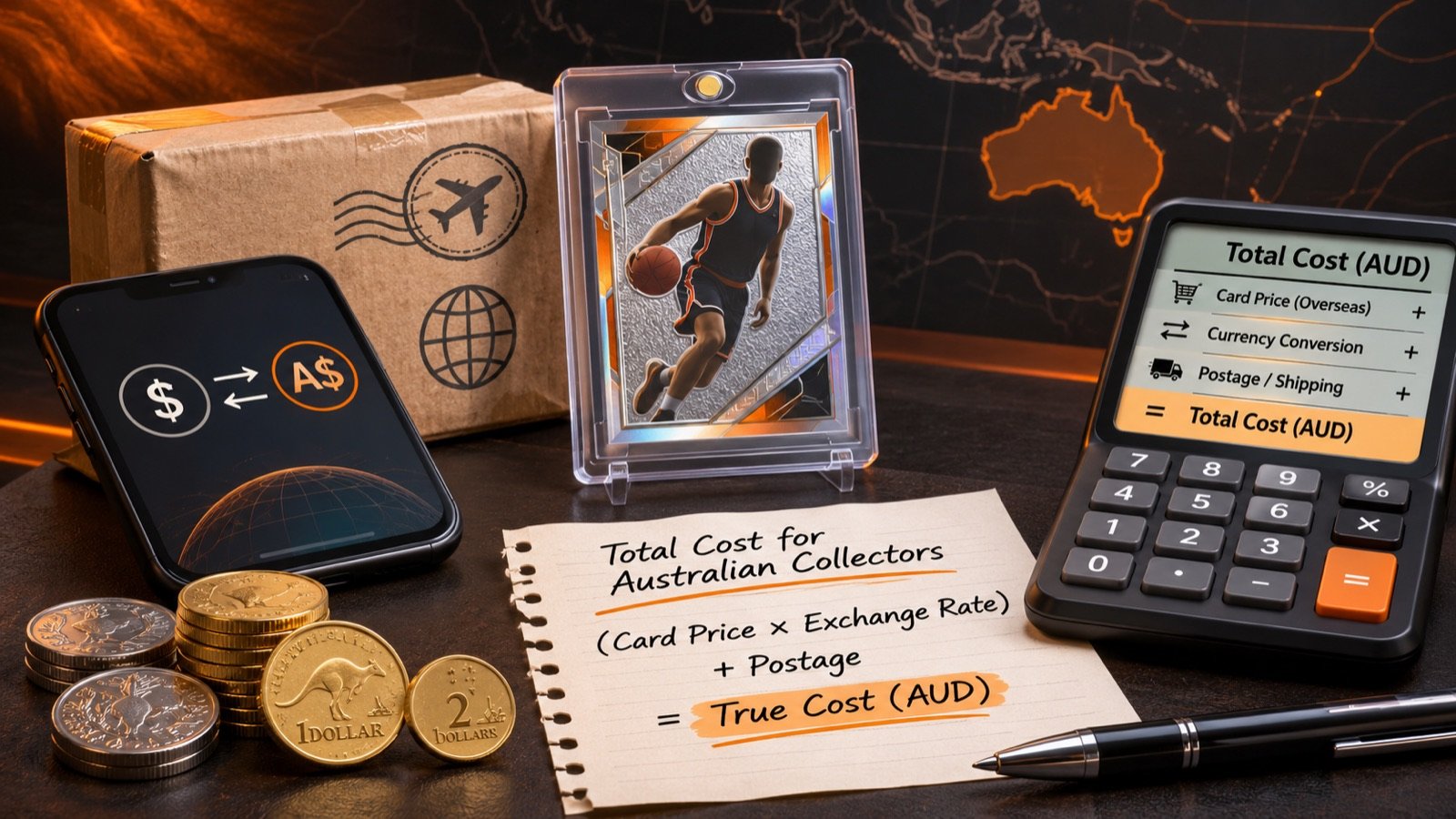
Australian collectors often compare sales from the United States, but the converted card price is not the full cost. Include the exchange rate used by the payment provider, international postage, taxes where applicable and any service or forwarding fees.
The Reserve Bank of Australia explains that an exchange rate is the value of one currency expressed in another and publishes reference exchange-rate data. Your bank, card provider or marketplace may use a different retail rate and may add fees, so calculate using the amount you would actually pay.
A practical maximum bid
Bid Defender uses a conservative 85 percent rule as a starting guardrail. Take your defensible market value, multiply it by 0.85, then subtract unavoidable postage or buyer costs. This creates a buffer for imperfect comps, resale fees and market movement. It is not a guarantee and may be too high or too low for a particular card.
Example: if your median comparable value is AUD 100 and buyer costs will be AUD 15, a cautious maximum card bid is around AUD 70: AUD 100 × 0.85, less AUD 15. Personal collectors may willingly pay more for a card they love. Buyers seeking margin usually need to be stricter.
When an auction is moving quickly, open Bid Defender to scan the card and narrow the search. Always verify the year, parallel, serial number and condition before treating a result as exact.
Step 6: decide whether grading makes sense
The decision to grade should be based on expected value, not excitement. Estimate the likely grade honestly, look at recent sales for that grade and compare the expected result with the raw value and every grading cost.
Do not build the calculation around the best possible grade unless the card genuinely supports it. Modern cards often need an exceptionally strong result to justify the cost. Vintage cards, important rookies, frequently counterfeited cards and valuable cards may benefit from authentication even when the numerical grade is not perfect.
Before submitting
- Inspect the surface under direct and angled light.
- Check front and back centering.
- Examine every corner and edge under magnification.
- Compare realistic grade outcomes, not only the highest grade.
- Confirm the grading company accepts that exact card.
- Include all costs and the time your money will be tied up.
Common basketball card pricing mistakes
Using active listings as proof of value
An active listing shows what a seller hopes to receive. It does not show that a buyer accepted the price. Use active listings to understand supply and current competition, then use sold results to estimate market value.
Comparing the wrong parallel
Silver, holo, shimmer, wave, cracked ice and colour parallels can look similar in photographs. Confirm the card number, finish and checklist name. A small difference can represent a large change in supply.
Mixing raw and graded sales
Do not average raw cards, PSA 10s and lower graded cards together. Separate each condition group and compare your card with the closest group.
Ignoring postage and currency
A cheap overseas sale can become expensive after conversion and shipping. Compare the final delivered cost in AUD.
Trusting one sale
One sale can be affected by poor photos, a misspelled title, an aggressive bidding contest or a seller with exceptional reputation. Use a group of sales whenever possible.
Treating rarity as automatic demand
A low print run limits supply, but it does not create buyers. Player popularity, card design, set reputation and timing still matter.
Useful live searches for your next comparison
The links below open active eBay Australia results and use the Sports Card Warriors affiliate tracking code. We may earn a commission from qualifying purchases at no extra cost to you. Study titles, photographs and current supply, then switch to sold results before deciding value.
You can also browse the Sports Card Warriors shop or discover breakers and singles sellers in the Aussie Sellers directory.
Use value as one part of the decision
A card can be fairly priced and still be the wrong purchase for your collection. Decide whether you are collecting a player, building a set, chasing long-term value or buying simply because you enjoy the card.
Use Stash or Pass to see which players the community believes are worth holding, then check the player leaderboard for the current collector verdict. These votes reflect community opinion, not guaranteed future prices.
For live breaks, singles auctions and collector shows, join Sports Card Warriors on Whatnot. Your invitation supports the site and helps you find live card sellers.
Frequently asked questions
What is the best free way to check a basketball card’s value?
Identify the exact card and compare several recent sold listings for the same version and condition. eBay completed listings are a useful free starting point. Do not use one active asking price as the value.
How many comparable sales should I use?
Three to ten close sales is a useful target when available. More data helps, but relevance matters more than quantity. Five exact matches are better than twenty loosely related cards.
What if my numbered card has never sold?
Create a value range using the same player in nearby parallels, similar players in the same parallel and older exact sales. Widen the comparison gradually and acknowledge the uncertainty.
Is a PSA 10 price the same as a raw card’s value?
No. A PSA 10 has passed professional authentication and condition assessment. A raw card carries uncertainty and should be compared with similar raw sales unless there is strong evidence supporting a likely grade.
Should I include postage in a comp?
Yes. The buyer’s total cost is the best comparison. A card sold for AUD 50 plus AUD 20 postage cost the buyer AUD 70.
How often should I update a card value?
Update it before buying, selling, insuring or making a major grading decision. Player performance, new products and collector demand can change recent market prices.
Can Bid Defender give a guaranteed value?
No pricing tool can guarantee a future sale. Bid Defender helps identify the card, surface market matches and create a cautious bid guide. You must still verify the exact version and condition.
Ready to practise? Try the Daily Challenge, explore Stash or Pass or scan your next card with Bid Defender.